
Views: 0 Author: Sunny Publish Time: 2026-10-02 Origin: Site


A raised floor cutting machine helps contractors cut large quantities of access floor panels faster and more consistently. Compared with handheld cutting tools, a band saw provides a stable cutting platform, better control over cutting lines, and easier operation for repetitive work. Its detachable design also makes transportation between job sites more convenient.
When installing a raised access floor, accurate cutting is just as important as choosing the right floor panel. Most raised floor panels are manufactured in standard sizes, but real construction sites rarely have perfectly rectangular layouts. Panels often need to be cut around walls, columns, doors, steps, equipment bases, cable openings, and other obstacles.
For small projects, a handheld cutting machine may be sufficient. However, when the project involves hundreds or thousands of raised floor panels, relying entirely on a handheld tool can make cutting slower, less consistent, and more labor-intensive.
This is where a raised floor cutting machine can make a significant difference.
A dedicated band saw cutting machine provides a more controlled cutting process, a stable cutting platform, and better efficiency for repetitive panel cutting. Although the initial purchase cost can be higher than that of a handheld cutting tool, the long-term benefits can make it a practical investment for professional installers, contractors, distributors, and raised floor manufacturers.
Quick Answer: A raised floor cutting machine is useful because it can cut large quantities of floor panels faster, provide better control over cutting accuracy, improve jobsite efficiency, and support repeated use across multiple projects.
For companies that regularly install or supply raised access floors, a professional cutting solution such as the MAJET raised floor cutting machine can become an important part of the installation toolkit.
A raised floor cutting machine is a specialized cutting tool designed to cut raised access floor panels into the required dimensions during installation.
Depending on the floor construction, raised floor panels may include:
Steel raised floor panels
Steel cement raised floor panels
Calcium sulphate raised floor panels
Woodcore raised floor panels
Chipboard raised floor panels
Aluminum raised floor panels
FRC raised floor panels
Other composite access floor panels
The exact cutting method depends on the panel material, thickness, reinforcement structure, and project requirements.
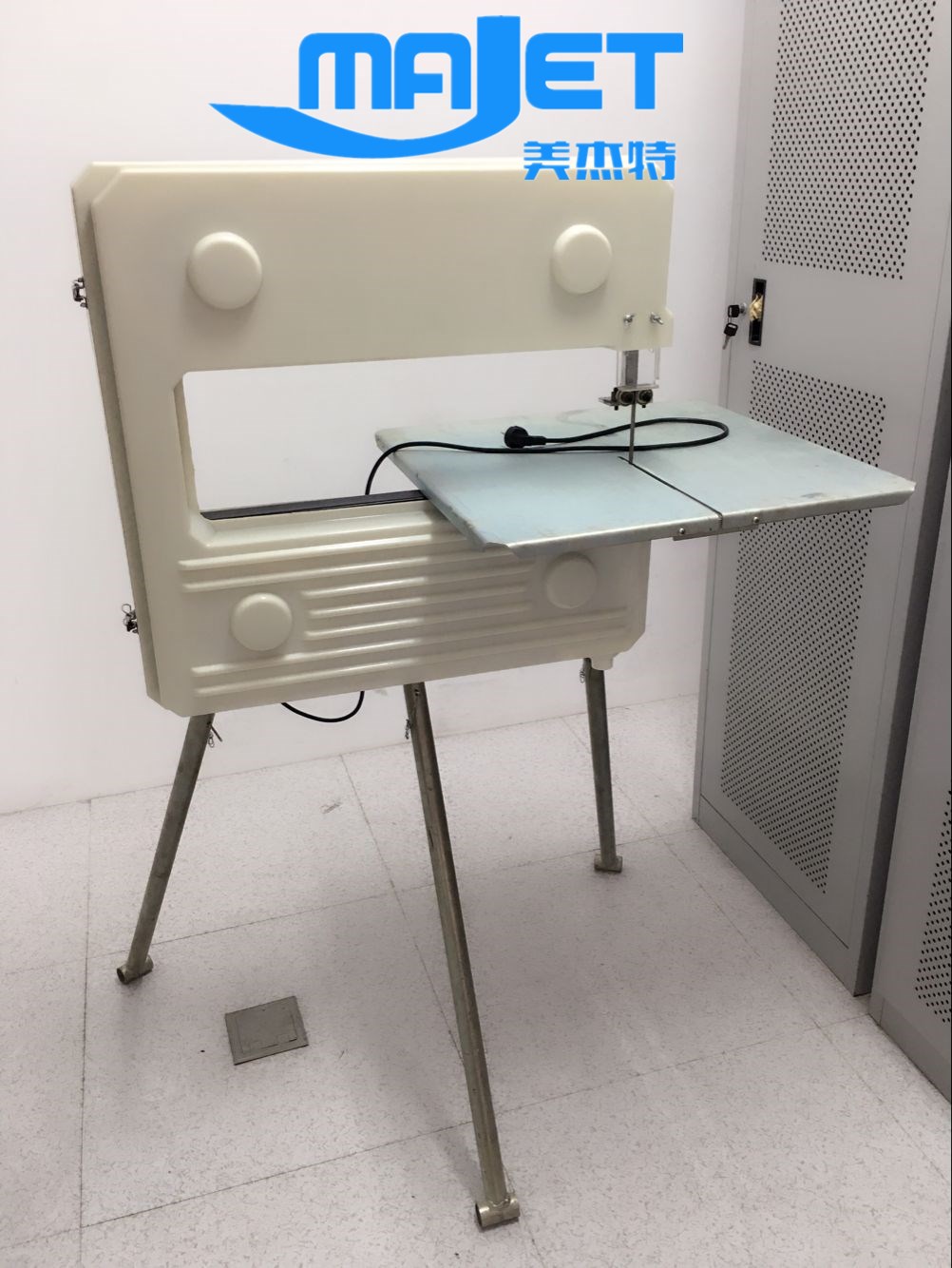
A band saw cutting machine uses a continuous blade running around two or more wheels. The panel is placed on a cutting table and guided toward the blade.
Compared with a handheld cutting tool, the machine provides a more stable cutting environment.
A typical raised floor band saw cutting machine may include:
Cutting blade
Motor
Cutting platform
Material guide
Supporting frame
Blade protection system
Control switch
Adjustable components
Detachable sections for transportation
The design can vary according to the manufacturer and intended application.
For raised floor installation companies, the most important advantage is not simply the cutting power. It is the combination of cutting speed, stability, repeatability, and operator control.
Raised floor installation often looks simple because the majority of panels have standard dimensions. However, the perimeter of a room usually requires many customized cuts.
Walls and columns rarely align perfectly with the standard 600 × 600 mm floor panel.
Even when the project uses standard-sized raised floor panels, installers may need to cut panels around:
Walls
Columns
Door openings
Corners
Cable penetrations
Floor outlets
Equipment bases
Ramps
Steps
Structural supports
Irregular room boundaries
This means that cutting is a normal part of professional raised floor installation.
For a small office renovation, only a limited number of panels may require cutting. But for a large data center, clean room, commercial building, or industrial facility, the number can become substantial.
A handheld cutting machine has an important advantage: it is relatively inexpensive, portable, and easy to obtain.
For small jobs, it can be a practical solution.
However, there is an important difference between cutting a few panels and cutting hundreds or thousands of panels.
A handheld cutting tool may be suitable when:
The project is small
Only a few panels need cutting
The installation site is difficult to access
The cutting requirements are occasional
The contractor does not regularly install raised floors
For these applications, purchasing a dedicated machine may not be necessary.
A professional raised floor cutting machine becomes more valuable when:
The project area is large
Many panels require cutting
Cutting is performed every day
The contractor handles multiple projects
Consistent cutting accuracy is important
Labor efficiency is a priority
The company wants to standardize its installation process
In other words, the question is not simply “Which cutting tool is cheaper?”
The more useful question is:
“How much time and labor will the cutting method save over the entire project?”
One of the biggest advantages of a band saw cutting machine is cutting efficiency.
When a project requires only five or ten customized panels, the difference in cutting speed may not be significant.
However, imagine a project where hundreds of panels need to be cut.
The time spent measuring, positioning, cutting, checking, and repeating the process can become a major part of installation labor.
Large raised floor projects often involve repetitive operations:
Measure the required dimension.
Mark the panel.
Position the panel.
Cut the panel.
Check the dimension.
Move the panel to the installation area.
Repeat the process.
A dedicated band saw can make this workflow more efficient.
The stable cutting platform allows the operator to position panels consistently instead of holding a heavy panel manually during the cutting process.
The value of a professional cutting machine is not only the speed of the blade.
It is the overall workflow.
If a cutting machine allows installers to complete the same amount of cutting work in less time, the project team can potentially spend more time on installation and less time preparing panels.
For contractors working on large data centers, offices, clean rooms, or industrial facilities, this difference can become meaningful.
Another important feature of a professional raised floor cutting machine is its cutting platform.
A stable platform provides support for the floor panel during cutting.
Raised floor panels can be relatively large and heavy.
When a panel is cut using a handheld tool, the operator must control several things simultaneously:
The tool
The panel
The cutting direction
The cutting line
The operator's position
This can make accurate cutting more difficult, particularly when the panel is large or the cut is long.
A cutting machine with a dedicated platform provides a more controlled setup.
The cutting platform helps keep the panel stable while it moves through the blade.
The operator can focus more directly on following the marked cutting line.
This can be particularly useful when the project requires many panels with similar dimensions.
A detachable cutting platform also has practical transportation advantages.
The machine can be separated into several components, making it easier to:
Transport between projects
Move through building entrances
Carry upstairs when required
Load into a service vehicle
Store after installation
Transport internationally
This is especially useful for contractors who do not keep the machine permanently in one workshop.
Accuracy is another reason to consider a dedicated raised floor cutting machine.
The purpose of cutting is not simply to make the panel smaller.
The finished panel needs to fit the installation location properly.
If a panel is cut too large, it may not fit into the required position.
If it is cut too small, an unnecessary gap may appear.
Large or inconsistent gaps can affect the appearance of the finished floor and may require additional adjustment.
For professional raised floor installation, accurate measurement and cutting are therefore important parts of the installation process.
A stable cutting table can help operators maintain a consistent cutting direction.
For repeated cutting tasks, this can make the process easier to standardize.
For example, if a contractor needs to produce multiple panels with a similar width, the operator can establish a repeatable measuring and cutting process.
This is particularly valuable for projects where installation teams need to process a large number of panels within a limited construction schedule.
A raised floor cutting machine does not necessarily need to remain in a permanent workshop.
Modern construction projects often require equipment to move between different locations.
This is why machine portability is an important consideration.
A large machine can be difficult to transport if it is manufactured as one fixed structure.
A detachable design can solve some of these practical problems.
A machine can be separated into several parts and transported individually.
This can make it easier for installation teams to move the machine through:
Building entrances
Elevators
Narrow corridors
Staircases
Construction areas
Service vehicles
For contractors working on multiple projects, this flexibility can be valuable.
At MAJET, the design of raised floor cutting equipment is intended to support real installation conditions.
Rather than treating the cutting machine simply as a workshop tool, MAJET considers factors such as cutting efficiency, operator control, transportation, and jobsite practicality.
This makes the machine suitable for contractors and installation teams that need to move equipment between projects.
One of the most common questions from buyers is:
“Why should I purchase a professional floor cutting machine when a handheld cutting tool costs less?”
The answer depends on how frequently the machine will be used.
A handheld cutting tool may have a lower purchase price.
A professional band saw cutting machine may require a higher initial investment.
However, purchase price is only one part of the total cost.
A professional contractor should also consider:
Cutting time
Labor cost
Project duration
Cutting consistency
Equipment utilization
Number of future projects
Operator efficiency
Maintenance
Transportation
Replacement cost
If the machine is used repeatedly, the initial investment can be spread across many projects.
For a contractor installing raised floors once every few years, a professional cutting machine may not be necessary.
For a specialist raised floor contractor completing several projects every year, the calculation can be very different.
The machine becomes a reusable production tool rather than a one-time purchase.
This is where the long-term value of a professional cutting machine becomes more apparent.
Not every buyer needs a dedicated cutting machine.
The most suitable users are generally companies that regularly handle raised floor projects.
Installation contractors can benefit from faster and more controlled panel cutting.
For large projects, the machine can become part of the standard installation equipment.
Distributors who also provide installation services may use the machine for customer projects, demonstration installations, or panel preparation.
Manufacturers may use cutting machines for sample preparation, customized orders, installation support, or project-specific processing.
Data centers often use raised access floors and may require a significant amount of panel cutting around equipment, walls, cable routes, and other building elements.
Clean room projects can also involve raised access floor systems and customized perimeter panels. Cutting equipment can help installation teams prepare panels more efficiently.
Before purchasing a raised floor cutting machine, buyers should look beyond the machine price.
Consider the types and thicknesses of floor panels you normally work with.
The machine should be appropriate for the materials used in your projects.
Check whether the platform provides sufficient support for the panel size.
A stable and practical platform can make daily operation easier.
If the machine will be moved between construction sites, check whether it can be disassembled into manageable components.
Ask about blade replacement, maintenance requirements, spare parts, and long-term operating costs.
Check whether the machine's electrical configuration is compatible with the destination country and project site.
For professional equipment, technical support and spare parts availability can be just as important as the initial purchase price.
A supplier such as MAJET should be able to discuss the intended floor type, project application, and cutting requirements before recommending a suitable configuration.
The decision can be simplified by looking at the project scale.
For a small project with only a limited number of cuts:
Handheld cutting tool → may be sufficient
For a medium-sized project with regular cutting requirements:
Handheld tool + dedicated cutting machine → depending on workload
For a large raised floor project involving substantial repetitive cutting:
Professional band saw cutting machine → worth considering
The key factor is not simply project size. It is the total cutting workload.
MAJET is focused on raised access floor systems and related installation equipment.
In addition to raised floor products, MAJET can provide equipment and accessories that support the installation process.
A professional raised floor project may require more than floor panels and pedestals.
The installation team may also need:
Raised floor cutting machines
Airflow panels
Perforated panels
Floor grilles
Floor outlet boxes
Brush grommets
Pedestals
Stringers
Installation accessories
This broader approach can help buyers source compatible products for their raised floor projects.
The cutting machine should not be viewed as an isolated piece of equipment.
It is part of the installation workflow.
The better the cutting process is organized, the easier it can be to coordinate measurement, panel preparation, installation, and final adjustment.
For this reason, MAJET recommends that buyers discuss their actual project requirements before selecting a cutting machine.
A raised floor cutting machine is a specialized tool used to cut raised access floor panels into customized dimensions during installation.
Yes. A handheld cutting machine can be used for some raised floor cutting applications, especially small projects with limited cutting requirements.
For projects involving a large number of repetitive cuts, a band saw can provide advantages in cutting efficiency, panel support, and operator control.
A cutting platform supports the floor panel during cutting and helps the operator maintain better control over the cutting direction and cutting line.
Many professional machines can be designed with detachable components, making transportation and jobsite movement easier.
A professional cutting machine usually costs more initially than a basic handheld cutting tool. However, buyers should consider the machine's long-term use, labor efficiency, cutting workload, and number of future projects.
Professional raised floor installers, contractors, manufacturers, distributors, and companies handling large or repeated raised floor projects are the most likely to benefit from dedicated cutting equipment.
MAJET provides raised floor products and related installation equipment. Buyers can contact MAJET to discuss their panel material, thickness, project size, cutting requirements, and destination before selecting a suitable cutting machine.
A raised floor cutting machine is not necessary for every project.
For a small installation with only a few customized panels, a handheld cutting tool may be enough.
However, the situation changes when the project involves a large quantity of raised floor panels.
A professional band saw cutting machine can provide several practical advantages:
Faster cutting for large quantities
Better panel support
More controlled cutting lines
More consistent cutting operations
Improved jobsite efficiency
Easier transportation when the machine is detachable
Better suitability for repeated projects
The initial purchase price may be higher than a handheld cutting tool, but the long-term value should be evaluated based on the machine's actual workload and frequency of use.
For professional raised floor contractors, the real question is therefore not “How much does the cutting machine cost?”
It is:
“How much time, labor, and installation efficiency can the right cutting machine provide over the lifetime of my projects?”
If your company regularly installs raised access floors and needs to cut a large number of panels, a dedicated raised floor cutting machine may be a practical investment.
MAJET can help buyers evaluate the appropriate cutting solution based on the raised floor material, panel thickness, project size, cutting quantity, and installation requirements. Contact MAJET to discuss your project and find a suitable raised floor cutting solution.

