- All
- Product Name
- Product Keyword
- Product Model
- Product Summary
- Product Description
- Multi Field Search

Views: 0 Author: Site Editor Publish Time: 2026-09-16 Origin: Site


Both systems can support flexible cable management and modular floor access, but their core materials create different performance characteristics.
Performance factor | Woodcore raised floor | Calcium sulphate raised floor |
|---|---|---|
Core material | High-density wood-based particleboard | High-density calcium sulphate / gypsum-based core |
Weight | Relatively lightweight | Relatively heavy |
Load performance | Suitable for many office and commercial applications | Suitable for applications requiring higher load performance, depending on system |
Fire performance | Combustible core; classification depends on the complete panel | Generally stronger fire performance; classification must be verified for the complete system |
Moisture resistance | Sensitive to moisture, especially at exposed cut edges | Better dimensional stability, but not immune to prolonged water exposure |
Acoustic performance | Good sound insulation and comfortable walking feel | Good acoustic performance and solid underfoot feel |
Installation and cutting | Easier to cut and handle | Heavier and generally more difficult to cut |
Initial cost | Often more economical | Usually higher |
Typical applications | Offices, commercial interiors, meeting rooms, light technical spaces | Data centers, server rooms, premium offices, control rooms, and demanding commercial environments |
Note: These are general material tendencies, not universal product ratings. Actual performance depends on panel construction, thickness, finish, pedestal system, and test method.
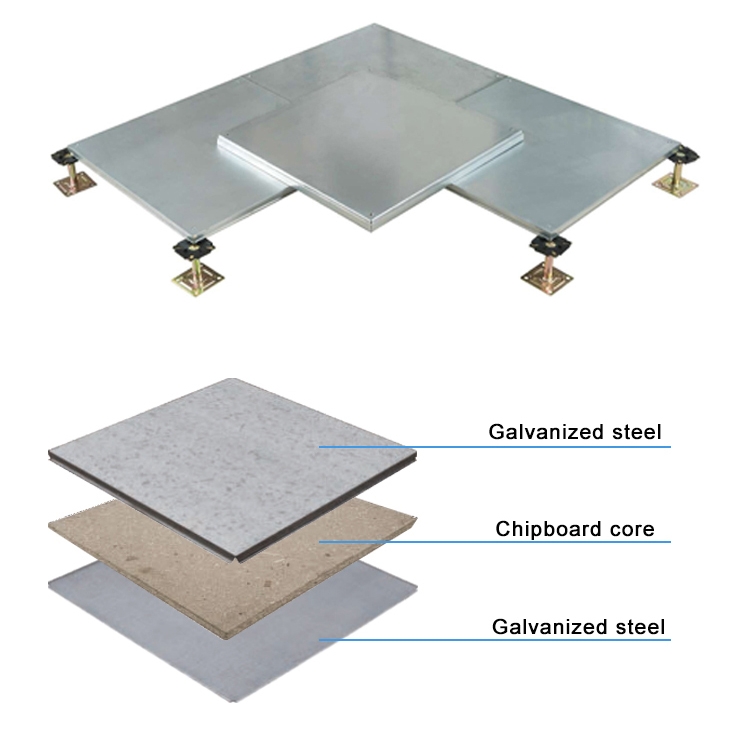
Woodcore raised floor, also called a wood-core raised access floor, uses a high-density wood-based panel as its structural core. The core is commonly enclosed or reinforced with materials such as galvanized steel, aluminum foil, or other protective layers. The top surface may be finished with HPL, PVC, carpet, rubber, linoleum, or other flooring materials.
A typical woodcore raised floor system includes:
High-density woodcore panel
Top and bottom protective covering
Edge protection or sealing
Adjustable steel pedestals
Optional stringers for additional lateral stability
Surface finish, such as HPL, PVC, or carpet
The finished system creates an accessible space below the floor for electrical cables, data cables, and other building services.
Woodcore panels are generally lighter than calcium sulphate panels of comparable dimensions and thickness. This makes them easier to transport, position, remove, and replace during installation or maintenance.
Why it matters: Lightweight panels can reduce manual handling effort and make projects with frequent access to underfloor services more convenient.
A European woodcore product example lists panel weights of approximately 9–11.5 kg for 600 × 600 mm panels, although specifications vary by construction and finish.
Wood-based cores can provide useful sound insulation and a comfortable walking sensation. In office environments, this can contribute to a less harsh acoustic experience than some harder floor constructions.
Why it matters: Offices, meeting rooms, libraries, and commercial interiors may value sound comfort as much as structural performance.
Acoustic results should still be assessed using the complete floor assembly rather than the core material alone.
Woodcore panels are generally easier to cut than dense calcium sulphate panels. This can be useful when installers need to create openings around columns, walls, cable penetrations, or irregular room layouts.
Why it matters: Projects with many perimeter cuts or frequent layout adjustments may benefit from easier field fabrication.
However, every field-cut edge must be properly sealed and protected. An exposed woodcore edge can absorb moisture and become vulnerable to swelling or delamination.
Woodcore raised floors are often selected when a project needs flexible underfloor cable access without the higher material cost or weight associated with some premium raised-floor systems.
Why it matters: For offices and commercial interiors with moderate loads and controlled indoor conditions, woodcore can provide a practical balance of functionality and cost.
The final project cost still depends on the finish, pedestal height, stringers, installation labor, and required performance testing.
Woodcore is more sensitive to moisture than inorganic core materials. If water reaches an exposed edge, damaged surface, failed seal, or unprotected cut, the core may swell, warp, or deteriorate.
This makes moisture control particularly important in:
Areas prone to water leakage
Damp basements
Spaces with frequent wet cleaning
Buildings with uncertain waterproofing
Locations exposed to condensation or high humidity
Important: Steel or aluminum encapsulation improves protection, but it does not make a woodcore panel waterproof under all conditions.
Woodcore contains organic material. Even when flame-retardant treatments or protective coverings are used, flame-retardant does not automatically mean non-combustible.
For projects with strict fire requirements, the complete raised floor assembly should be assessed against the applicable fire classification. In Singapore, for example, the SCDF Fire Code addresses raised floors with combustible cores and specifies conditions concerning protection, covering, and building fire-safety provisions.
Do not select a woodcore floor for a critical environment solely because a supplier describes it as “fire resistant.” Request the relevant test classification and confirm that it meets the project specification.
Woodcore raised floors can offer adequate load performance, but the rating varies considerably by panel construction. Prolonged heavy loading, moisture exposure, or damage to the encapsulation can affect long-term performance.
For server racks, battery cabinets, heavy equipment, or frequent trolley traffic, verify:
Concentrated load
Uniform load
Rolling load
Impact load
Deflection
Ultimate load
Pedestal and stringer configuration
A product's nominal load rating should not be treated as a guarantee for every installation condition.

Calcium sulphate raised floor uses a high-density calcium sulphate-based panel as its core. Calcium sulphate is a mineral-based material commonly associated with gypsum. The panel may be factory-finished with HPL, PVC, carpet, or other surfaces and supported by an adjustable pedestal system.
A typical calcium sulphate raised floor system includes:
High-density calcium sulphate core
Surface finish
Protective underside or encapsulation, depending on design
Edge treatment
Adjustable pedestals
Optional stringers
Optional conductive or anti-static components
The material is widely considered for projects where fire performance, dimensional stability, acoustic behavior, and structural performance are important.
Calcium sulphate raised floor panels are available in a range of load classes and can be designed for demanding commercial and technical applications.
Their high-density mineral core provides a solid structural base. However, the actual capacity depends on the panel thickness, steel or aluminum encapsulation, pedestal spacing, stringer system, and testing method.
Why it matters: Calcium sulphate is worth considering where concentrated equipment loads, heavy cabinets, or frequent traffic require a carefully specified raised floor system.
Always compare tested values rather than relying on the material name alone.
Calcium sulphate is an inorganic mineral-based core, so it generally offers stronger fire performance than an exposed wood-based core.
Depending on the complete construction and tested classification, calcium sulphate panels may achieve high fire-reaction ratings. However, A1, A2, or another classification must never be assumed without a valid test report for the actual product.
Why it matters: Fire performance is especially important in data centers, hospitals, transportation facilities, public buildings, and other projects with strict fire-safety specifications.
Calcium sulphate panels generally offer good dimensional stability under normal indoor conditions. Compared with wood-based cores, they are less vulnerable to moisture-related swelling and warping when the product is correctly manufactured and installed.
Why it matters: Stable panel dimensions help maintain a level, consistent floor surface over time.
Nevertheless, calcium sulphate is not suitable for prolonged immersion or uncontrolled water exposure. Moisture resistance must be verified for the specific panel construction.
Calcium sulphate panels provide a dense, solid feel underfoot and can offer good sound insulation. This makes them attractive for offices, commercial buildings, and technical spaces where acoustic comfort and floor stability are both important.
Why it matters: A raised floor should not only carry equipment; it should also perform well as part of the occupied building environment.
Calcium sulphate panels are generally heavier than woodcore panels of comparable size. This can increase:
Transportation and handling effort
Installation labor requirements
Structural dead load
Difficulty during panel removal and replacement
A published comparison of 600 × 600 mm panels gives an example of approximately 18 kg or more for calcium sulphate versus around 10 kg for woodcore, but actual weights vary significantly by thickness and construction.
Project consideration: For renovations or buildings with structural load limitations, calculate the additional dead load before selecting the system.
Calcium sulphate raised floors often cost more initially than basic woodcore systems because of material density, manufacturing, handling, and the performance requirements of the applications in which they are commonly specified.
However, initial purchase price is only one part of lifecycle cost. A higher-cost system may be justified when it reduces performance risks or better meets fire, load, and durability requirements.
The dense mineral core can make calcium sulphate panels more difficult to cut on site than woodcore panels. Installers may need suitable cutting tools, dust control, and more careful edge treatment.
This is especially relevant when a project involves:
Numerous irregular perimeter cuts
Frequent cable openings
Complex room geometry
Repeated layout changes
Factory planning and accurate panel layout can reduce site modification work.
Calcium sulphate is often described as moisture-resistant or dimensionally stable, but that does not mean it can withstand permanent standing water or prolonged immersion.
For areas with significant water exposure, evaluate:
Core water absorption
Edge sealing
Encapsulation quality
Surface finish
Drainage and leak protection
Manufacturer's moisture test data
A sealed calcium sulphate panel and an exposed calcium sulphate core should not be treated as having the same moisture performance.
Calcium sulphate often has an advantage when higher load performance is required, but the product's tested rating is more important than its core material.
Raised floor load performance includes more than a single concentrated-load number.
Load parameter | What it measures | Why it matters |
|---|---|---|
Concentrated load | Load applied over a defined small area | Equipment feet, rack supports, cabinet legs |
Uniform load | Load distributed across a larger area | General equipment and room occupancy |
Rolling load | Repeated movement of wheels or casters | Trolleys, equipment transport, maintenance carts |
Impact load | Resistance to sudden loading | Installation and operational accidents |
Ultimate load | Load at failure under the test method | Structural safety reference |
Deflection | Panel movement under load | Floor stability, alignment, and serviceability |
For example, EN 12825 is used in raised access floor testing and classification, but a load value is meaningful only when the test method, panel configuration, and installation conditions are clear. A published woodcore specification from CBI Europe reports tested load values under a stated EN 12825 test method, demonstrating why product-level data is necessary rather than relying on generic material claims.
Practical guidance:
For ordinary office furniture and moderate traffic, both materials may be suitable.
For heavy server cabinets, battery systems, or equipment with small feet, focus on concentrated load and pedestal support.
For frequent trolley movement, rolling-load data is essential.
For high-load data centers, compare calcium sulphate with heavy-duty steel or aluminum systems rather than assuming calcium sulphate is automatically the best solution.
Calcium sulphate generally offers a stronger starting point for fire performance because its core is mineral-based.
Woodcore panels contain combustible organic material. Protective steel sheets and fire-retardant treatments can improve the performance of the complete product, but they do not change the basic fact that the core is wood-based.
Factor | Woodcore | Calcium sulphate |
|---|---|---|
Core composition | Organic wood-based material | Inorganic mineral-based material |
Combustibility | Core is combustible | Core generally has low combustibility |
Fire classification | Must be tested for complete assembly | Must be tested for complete assembly |
Project implication | May require additional fire-safety review | Often considered where higher fire performance is required |
Important distinction: Fire reaction and fire resistance are not the same.
Fire reaction describes how a material contributes to fire, such as ignitability, flame spread, smoke, and droplets.
Fire resistance describes how a construction performs for a specified period under a fire-resistance test.
For example, EN 13501-1 is a fire-reaction classification standard, while fire-resistance claims require the relevant test classification and assembly details.
For buildings with strict fire codes, consult the local authority requirements and request the actual product test report. The SCDF Fire Code illustrates how requirements may differ depending on whether the raised floor has a combustible core, whether the building is sprinkler-protected, and how the concealed space is constructed.
Neither material should be selected without considering the complete moisture-control strategy.
Moisture factor | Woodcore | Calcium sulphate |
|---|---|---|
Normal dry indoor environment | Suitable | Suitable |
High humidity | Requires careful protection | Generally better dimensional stability |
Exposed cut edges | High risk if unsealed | Still requires edge protection |
Standing water | Not recommended | Not recommended without specific product approval |
Water leakage risk | Requires strong preventive measures | Requires strong preventive measures |
Woodcore is particularly sensitive to moisture reaching the substrate. Calcium sulphate generally performs better against moisture-related dimensional change, but its core can still be damaged by prolonged water exposure.
Best practice for either system:
Identify possible water sources.
Ensure the structural slab is dry and suitable.
Seal all field-cut panel edges.
Protect penetrations and openings.
Use appropriate moisture barriers where required.
Never treat a raised floor plenum as a substitute for waterproofing.
Both woodcore and calcium sulphate can provide good acoustic performance, but their behavior differs.
Woodcore raised floors:
Often provide a slightly softer walking feel.
Can offer useful sound insulation.
May be preferred in office interiors where comfort is important.
Calcium sulphate raised floors:
Provide a denser, solid walking feel.
Can offer good airborne and impact sound performance depending on construction.
May be preferred where stability and acoustic performance are both required.
Actual acoustic performance depends on:
Panel density and thickness
Surface finish
Pedestal height
Stringer configuration
Underfloor cavity
Building structure
Acoustic underlay or isolation components
Do not select solely by core material if the project has strict acoustic targets. Request test data for the complete floor assembly.
Weight is an important factor that is sometimes overlooked when comparing raised floors.
For a large project, even a small difference in panel weight can affect the building's total imposed dead load.
Check before selecting calcium sulphate:
Existing slab and structural design
Maximum allowable floor loading
Raised floor panel weight
Pedestal and stringer weight
Equipment loads
Future load changes
Check before selecting woodcore:
Required concentrated load
Long-term heavy equipment loading
Moisture exposure
Fire classification
Panel edge protection
Installation factor | Woodcore | Calcium sulphate |
|---|---|---|
Panel handling | Easier due to lower weight | More labor-intensive |
Site cutting | Generally easier | Requires more suitable tools |
Edge sealing | Essential | Essential |
Panel removal | Convenient | More effort due to weight |
Frequent access | Practical | Practical, but heavier |
Installation waste | Often easier to manage | May require more careful cutting |
For both systems, the quality of installation affects the finished floor's performance. A high-rated panel can still fail to perform properly if:
Pedestals are incorrectly spaced
Pedestals are not level
Stringers are missing where required
Panels are not properly supported
Cut edges are not sealed
The floor is overloaded beyond its tested configuration
There is no universal winner. The following guidance matches common project priorities with the characteristics of each material.
Woodcore may be suitable when:
Loads are moderate.
The environment is dry and climate-controlled.
Lightweight panels are preferred.
Budget and ease of cutting are important.
Acoustic comfort is a priority.
Calcium sulphate may be suitable when:
The project requires stronger fire performance.
Higher load requirements apply.
A solid underfoot feel is preferred.
Long-term dimensional stability is a key consideration.
Selection focus: Load class, fire classification, acoustic requirements, finish, and total installed cost.
Calcium sulphate may be a strong candidate when the project prioritizes:
High fire-performance requirements
Structural stability
Concentrated equipment loads
Acoustic performance
Long-term dimensional stability
But material selection should not stop at calcium sulphate. Data centers may also require heavy-duty steel or aluminum raised floors, especially where rolling loads, high equipment loads, corrosion resistance, or airflow design are critical.
Selection focus: Concentrated load, rolling load, uniform load, fire classification, ESD performance, airflow requirements, pedestal stability, and equipment loading.
For data center cooling, the raised floor system must also be assessed as part of the airflow design. Perforated panels, grilles, dampers, and the underfloor plenum all influence cooling performance.
Both materials may be appropriate depending on the equipment and building requirements.
Woodcore may fit: Moderate-load control rooms with dry indoor conditions and a strong need for easy access and cost efficiency.
Calcium sulphate may fit: Technical spaces with higher fire, acoustic, or load-performance requirements.
Selection focus: Equipment footprint, concentrated loads, fire regulations, ESD requirements, and frequency of maintenance access.
Neither woodcore nor calcium sulphate should be selected automatically for every cleanroom or industrial project.
Cleanrooms may require specific performance relating to:
Particle control
Chemical resistance
Static control
Moisture resistance
Cleaning chemicals
Load capacity
Surface integrity
Depending on the environment, aluminum, steel, or specially engineered raised floor systems may be more appropriate than either woodcore or calcium sulphate.
Selection focus: Cleanroom classification, chemical exposure, cleaning method, ESD, load requirements, and applicable project standards.
Rather than choosing by material name alone, use the following six-step process.
Ask:
Is this an office, data center, server room, control room, or cleanroom?
Is the space dry, humid, or exposed to water risks?
Will the floor be frequently opened?
Is the floor used as an air plenum?
Are there special fire regulations?
Example: A dry office with moderate loads may have different requirements from a data center with heavy racks and strict fire controls.
Do not rely only on the weight of the equipment.
Consider:
Equipment total weight
Number of equipment support points
Footprint of each support point
Concentrated load at each point
Uniform load across the room
Rolling loads during installation
Dynamic or impact loads
Future equipment expansion
For example, a heavy cabinet may have a relatively low total weight but create a high concentrated load if it rests on only a few small feet.
Request: Concentrated-load and rolling-load test data for the complete raised floor system.
Determine:
Required fire-reaction classification
Required fire-resistance performance, if applicable
Whether combustible core materials are permitted
Whether the underfloor cavity is used as a plenum
Whether local fire authorities impose additional requirements
Rule of thumb: If fire performance is a major project constraint, calcium sulphate may be a more natural starting point for evaluation, but the final choice must be based on verified test results and local code compliance.
Ask:
Is there a risk of water leakage?
Is the room above a basement or wet area?
Are there HVAC condensation risks?
Will the floor be cleaned with water or chemicals?
Are cut edges likely to be exposed?
If moisture risk is significant, do not assume either panel is suitable without checking the manufacturer's technical data.
Compare more than the panel price:
Cost factor | Why it matters |
|---|---|
Panel price | Basic material cost |
Pedestals and stringers | Required for system stability |
Surface finish | HPL, PVC, carpet, rubber, etc. |
Cutting and installation | Calcium sulphate may require more handling effort |
Transport | Heavier panels can increase logistics costs |
Maintenance | Panel removal and replacement frequency |
Structural impact | Additional dead load may affect renovation costs |
Performance testing | Required for project approval and compliance |
A lower purchase price does not always mean a lower project cost.
Before placing an order, request:
Product technical datasheet
Panel dimensions and thickness
Concentrated-load test report
Uniform-load data
Rolling-load test data, where relevant
Fire classification report
Moisture-performance data
ESD / electrical resistance data, if required
Acoustic test data, if required
Installation instructions
Warranty and quality-control information
For European projects, ask how the product is tested against relevant raised access floor standards, such as EN 12825, and ensure the test report corresponds to the actual panel and support configuration.
The cheapest panel may not meet the project's load, fire, or durability requirements. Compare the complete installed system.
Calcium sulphate generally has better moisture stability than woodcore, but it is not automatically suitable for prolonged water exposure.
A fire-retardant treatment does not necessarily make a wood-based core non-combustible. Check the actual classification.
A floor may pass a concentrated-load test but still require evaluation for rolling load, impact, deflection, and pedestal stability.
A heavier calcium sulphate system may affect the structural dead load of an existing building.
Field-cut edges must be sealed according to the manufacturer's installation instructions. This is particularly important for woodcore panels.
Raised floor performance depends on the entire system:
Panel + pedestal + stringer + installation configuration + load distribution
A panel's published rating may not apply if it is installed with a different pedestal spacing or support arrangement.
Calcium sulphate can be a better fit when a project prioritizes fire performance, dimensional stability, and higher load requirements. Woodcore can be a practical choice for lightweight, cost-conscious commercial interiors with moderate loads and controlled moisture conditions. The better option depends on the project's requirements.
Calcium sulphate raised floors often offer higher load-performance potential, but strength depends on the specific panel construction and support system. Compare certified concentrated-load, uniform-load, and rolling-load test results rather than relying only on the core material.
Woodcore may be used in some data center or technical-room applications, but suitability depends on the project's load, fire, moisture, ESD, and local code requirements. For critical data centers with strict fire and heavy-load requirements, calcium sulphate, steel, or aluminum systems may be considered depending on the specification.
No. Calcium sulphate raised floors are not automatically waterproof. They may offer better moisture stability than woodcore, but prolonged water exposure can still damage the panel. Proper waterproofing, edge protection, and moisture control remain necessary.
Woodcore raised floor panels are generally lighter than calcium sulphate panels of comparable dimensions and thickness. The exact weight depends on the panel structure, finish, encapsulation, and manufacturer.
Woodcore panels are generally easier to cut and modify on site. Calcium sulphate panels are denser and may require more suitable cutting equipment and dust-control procedures.
Environmental performance depends on the complete product and its lifecycle, including raw materials, recycled content, manufacturing, transport, durability, and end-of-life options. Calcium sulphate and woodcore should be compared using verified environmental product data rather than assuming one is always more sustainable.
Depending on the project location and specification, check relevant raised access floor standards such as EN 12825, applicable fire classification standards such as EN 13501-1, and project-specific ESD, acoustic, or building-code requirements. Always request test reports for the actual product.
Choose woodcore raised flooring when lightweight handling, easy cutting, acoustic comfort, and cost efficiency are important—and when the environment and performance requirements are suitable for a wood-based core.
Choose calcium sulphate raised flooring when fire performance, dimensional stability, structural performance, and a solid underfoot feel are higher priorities—and when the building can accommodate its greater weight and cost.
For demanding applications, do not limit the comparison to these two materials. Steel and aluminum raised floor systems may also be appropriate, particularly when the project has specific requirements for heavy loads, industrial conditions, corrosion resistance, or cleanroom performance.
The most reliable selection method is simple:
Define the environment → calculate the loads → verify fire and moisture requirements → compare tested system performance → evaluate total installed cost.
A raised floor is a complete engineered system, not just a panel. Choosing the correct combination of core material, finish, pedestal, stringer, and installation method is what determines long-term performance.
If you are comparing woodcore raised floor, calcium sulphate raised floor, steel raised floor, or aluminum raised floor for an office, data center, or commercial project, MAJET can help you evaluate the appropriate system based on your application.
When requesting a quotation, provide:
Project location
Application
Required panel size and height
Concentrated and uniform load requirements
Surface finish
Fire-performance requirements
Quantity
Installation or delivery requirements
Contact MAJET for raised access floor product specifications, technical data, and a project-specific quotation.


